Showing posts with label stitching. Show all posts

Thursday, December 23, 2010

Community stitching

On both Monday and Wednesday this week, we spent most of the sessions stitching. On Monday we did a short brainstorm of what kinds of details the could put into their images. I copied compositions from the student's appliques onto the board and the students made suggestions on what would tell people more specifically that it was a rural/suburban/urban view. We reviewed some of the stitches, since the students haven't stitched in a few weeks: running, whipped running, satin, and couching stitches. 
Amanda outlines a sun before filling it in with satin stitch
 We compared the applique compositions to main idea and the embroidery stitches to details in a story. Cindy and I helped kids get started and solve any stitching snafus, but by now most of the children are confident in threading needles and tying knots.
Tyler works on windows and a bowl to feed the dog he'd included in the applique
 Suns, windows and doors, streams and ponds were popular additions. One girl even figured out how to make a squirrel! As always in embroidery, I stress that if you can draw it with a pencil, you can stitch with a needle and thread!! Most of the students approached it in this more freeform, direct way, stitching designs directly on the fabric without drawing it first, showing me how well they understood this drawing on paper/stitching on fabric comparison.
Erin's purple, whip-stitched windows really stand out on the yellow house
 Many students discovered that the whipped running stitch and the satin stitch made bolder images to show up on the patterned and brightly colored fabrics.
 I'm very excited by Daniella's, below. Her bush has tiny red berries in a sparse seed stitch she came up with on her own as well as satin stitch sun, stream, and a sidewalk in front of her house.
On Monday we administered the Science post-test, since we've completed our work on river systems and have moved on to the social studies portion. I'll post details on that later, but they did very well! On Wednesday we also prepared the children's timeline books to be hung in the hall- I had finished sewing their early rivers-of-the-world maps into bags and brought them in in which to place the accordion books.
There's  a short break for the Winter holidays, but we'll be back to finish up our last 6 days in January. When we come back we'll be doing some problem/solution writing based off the choices they made in their little community stitching, and then compile the stitcheries to be added to the collaborative project.

Thursday, November 25, 2010

Plants of the Delaware and River words brainstorm

On Friday, I hung up the collaborative Delaware River map for the kids to copy into their sketchbooks while a few of the students finished up their leaf embroideries. Cindy helped the embroiderers while I got set up for our lesson. We brought in the laptop and projector in order to take a look at a satellite view of our watershed. The kids noticed that the satellite view was like a bird's-eye view. We located the Delaware and compared it to the fiber version to make sure we could find all our river parts (source, meander, tributary, mouth/delta).
looking at the satellite view-
the kids were excited to see the zoom in and out to see the world
and then their school close-up
 We pointed out the low land in Pennsylvania, Delaware, and New Jersey where there are many farms and a lot of "green" on the satellite view. We brainstormed with the kids some of the plants and crops that grow in our area, based on the farms they've seen or visited, or fruits and vegetables they eat at home. They came up with strawberries, corn, tomatoes, blueberries, pumpkins, watermelons, and carrots. We even noted that Chester County, PA is famous for mushrooms! We saw lots of green in NJ, and I pointed out the gigantic forest of pine trees called the Pine Barrens. We looked at the mountains and talked about why there aren't many farms up in the mountains, because of colder temperatures and rough, rocky terrain, but there are lots of forests.
Emily cuts out her embroidered leaf
 Next we transitioned to cutting our leaves out to place on the collaborative Delaware River map. I asked the students to decide where they wanted to put their leaf, mark it on their drawing, and have a reason why they wanted it there. I showed the students my sample cut-out leaf, and Cindy noted it was an organic shape not a geometric shape.
Liz decides where her leaf should go on her map
 and Justin shares his leaf ready to pin up
 Cindy supervised the cutting-out while I stayed near the river model ready to pin the kids' leaves as they were finished.As students completed cutting out their leaf, they came up to me with their leaf and sketchbook to tell me where they wanted their leaf to go and why. Some chose spots in New Jersey because that's where they go in the summer. Some wanted their leaf up in the mountains with the forests. A few wanted to be in the suburbs because there are lots of trees where they live.
the giant river model before the leaves got pinned
When all the leaves went up, we moved on to brainstorming for our next project- a river poem to add to our map. Cindy helped keep us on track for what kind of words and language they'll need for writing their cinquain next week by prompting possibilities as I wrote the students' words up onto the board into a giant word splash. The children created their own version in their sketchbooks, taking notes, which finally, we had them go back and color/circle words they think they'll want to use.

Sunday, November 21, 2010

Leaf stitching

On Friday the students had a chance to embroider their leaf rubbings to make one of them stand out through bright color and to add detail. I introduced a new stitch to them- satin stitch to make thick lines. Cindy and I helped the students with threading needles, tying knots, and problem-solving.
 For the most part it was a quiet and productive way to end the week.
 I believe the metaphor of stitching in this project is that embroidering is a way of adding detail to an image just like we add detail to a main idea. The stitches and colors are like the variety of vocabulary one uses to make a written piece more interesting. I think we need to make that connection more explicit.
 Craftsmanship is surprisingly high among these students in their stitching. I see mostly careful, even stitches. Only 2 students needed help couching down giant floats on the surface, whereas last year at least a 3rd of each class had trouble with the concept of even size and even space stitching. It makes me wonder how their measuring and ruler skills or their estimating skills are in Math.
 This surprises me to an extent, as their handwriting is not as careful, and I've seen them rush through other activities. Hopefully this process helps develop fine motor skills and attention span that could be transferred to other domains.
Another curious aspect of the students' work process is that so many of them feel compelled to stand up while they stitch. I don't mind if they stand, except then sometimes they start to wander and clump into social groups. I think perhaps when they sit they don't feel like they have full extension of their arm for pulling the thread through the fabric.

Friday, October 29, 2010

Day 12, finishing up Rivers of the World

On Wednesday when I came in, Cindy was having the kids review the "6-pack" for the Amazon river to transform the important points into sentence form. We hadn't done our 6-packs (the people, houses, plants, animals, problems, and uses) for the Nile, Volga, and Yangtze the other day in hopes to get lots of stitching done. So after they had completed the Amazon facts, we picture-walked through a book on the Nile River, with Cindy reading out loud, the students taking notes to add to a new 6-pack, and me writing down main points on a large sheet of paper to mirror the Amazon one they'd completed. This set us up perfectly for a Venn diagram organizer for a compare/contrast writing. I believe this was the first time they'd been introduced to the compare/contrast format and concept. With diagram handouts in the kids hands and a larger Venn diagram poster on the board I elicited what was the same about the Nile and Amazon to put in the overlapping section, and then what was special and different for each of the rivers to put in the left and right sides of the diagram. The children naturally made comparison statements like "The Nile is longer than the Amazon", and I pointed out that we use sentences like that a lot when making comparisons, especially using words such as less/more and -er endings. It would be great to continue this idea with some images, and perhaps we can spend a few moments tomorrow on comparing their maps to reinforce the idea of compare/contrast. Images are great for this kind of activity, and compare/contrast is an essential form for writing about art and aesthetics. With the Venn diagrams complete, Cindy collected them for use in their next writing assignment.

We brought up the overhead transparency of our Rivers of the World map to review which rivers have been studied and stitched so far (Mississippi, Amazon, Nile, Volga, and Yangtze), we counted out how many that was (5) and compared that to how many continents there are (7). I asked them which continent we hadn't done yet (Australia) and also asked why we weren't going to stitch any rivers in Antarctica (nobody lives there and it's too cold there for rivers to flow). We passed out the Atlases and had them find Australia and its major river (the Murray-Darling). I compared it to the Amazon river because both have their sources up in the mountains, and I compared it to the Nile river because both start as 2 separate rivers that join and have one mouth. We discovered a new word for a body of water-- the Murray-Darling's mouth is in the Great Australian Bight (a shallow, curved bay). As always I asked them to find the source of the river as their starting point for stitching and the mouth as the end point for stitching the river. I'm hoping this process of starting and ending in stitching will reinforce the idea of the beginning and end of the river and direction a  river flows.

Students quickly finished their stitching and as we had plenty of time, I brought out my fabric markers. I told them this was their chance to make their map their own and unique. I mentioned some options such as coloring in the continents like the map on the classroom wall, labeling the continents and the rivers, adding details to each continent and river based on the information they had learned from our six-pack exercises, etc. The children were VERY enthusiastic about coloring these in and were quite inventive in the details they added. Some added compass rose and cardinal directions, some created a color-coded map key, some wanted to add the equator, some drew animals and fish in the land and water. They had a clear idea about what should be on a map!
Now my challenge is making a final decision about how to make these more "finished" pieces in terms of the edges. I could either mount them on boards and tape the edges at the back, or I could be more labor intensive and add a backing fabric and seam the edges........

Saturday, October 23, 2010

Rivers of the World: Asia, Europe, and Africa

Today was a big catchup day. We decided to just do embroidery of the various rivers instead of doing an individual book exercise, then stitching. We reviewed the names of the continents and rivers we've learned so far. We had the kids work with the atlas, which they seem to be getting more familiar with. First we found Africa, and the kids quickly located the Nile. We noted the source in Uganda, that it travels through 3 countries, is the longest river in the world, and that the mouth is in the Mediterranean Sea. I had pre-threaded the needles today to help us get started faster. I was able to show them a new stitch- Whipped running, and several students used it.
We moved our hoops over to look at the continents of Asia and Europe. We sang the continents song again. We located the Volga River which sort of helps divide the continents of Europe and Asia. After they stitched the Volga we traveled across Asia to find one of the major rivers in China. We noted the location of the Yangtze, its source, and its mouth at the Sea of China. Some students were able to finish stitching the Yangtze, but others have not yet. It was time to get cleaned up and ready for the bus.

After today, to complete the project we only need to have the Yangtze and a river in Australia stitched. To review the Houses, People, Plants, Animals, etc. Cindy and I discussed just focusing on the Amazon and the Mississippi, and having the kids create a Venn diagram in their sketchbooks to compare and contrast. Some additional details can be added to their maps based on the information gathered. We're concerned with the kids' reading progress and need to find more ways to work in the literacy goals. As we'll be moving on to our river model,  I recalled seeing a grade-appropriate description of river features in Cindy's collection of materials during our planning sessions we can use next week.

Wednesday, October 20, 2010

Amazon River

Today we were back in the classroom. It was a little weird having all those trips to skip back to our previous subject matter. Our goal was to cover the Amazon river of South America in our Rivers of the World exploration. We started off looking at the atlas to locate South America and its rivers. The students quickly found the Amazon. I asked them to find the equator, which was also a little blue line, but didn't meander. We also pointed out the equator on the globe to show how it went all the way around the world. I explained how it was always hot near the equator and Cindy reminded the students of previous discussions about climate and seasons.
We then gathered the students and I read a book on "Rainforests", highlighting the Amazon region. Reading the book brought up many of the people, plants, animals, problems, and uses of the Amazon River. Cindy created a word splash for our vocabulary as I read and we explained. Cindy then did a picture walk on 2 books about the Amazon specifically as the students took notes on the people, houses, plants, animals, problems, and uses. I don't know if it was because of the content presented or because the kids were more familiar with the note-taking process, but our chart for the Amazon seems much more full than the one for the Mississippi. Throughout the lesson Cindy and I made comparisons between what we were introducing to what the students had already learned in class and on the fieldtrips.
To complete our Amazon lesson we passed out the students' world map embroideries. I reminded them of how to move the hoop and reviewed the tool vocabulary. I traced the path of the river on the overhead transparency and reviewed source and mouth vocabulary. We quickly passed out the materials and helped the students thread and knot to be ready to stitch.
Once again we went overtime, and the art portion was very rushed. I'm wondering how it might work to do the atlas portion, then stitch the river, then do the book activities and chart. I wanted the students to add imagery based on the 6 chart points for rivers, but there hasn't been time. Perhaps as a culminating activity instead, students can work on the continent/river they found most interesting to add detail to the map when we're finished stitching. Cindy noted that last year I had the students do a practice/free embroidery before they worked on their final projects. I didn't do it this time because of how pressed for time we are. I think the stitching was better on the first day. They really need another review of technique.
Today was a bit difficult because the kids had a half day and there was a lot of nervous energy and noise. Hopefully on Friday we'll be more on task.

Wednesday, October 6, 2010

Rivers of the World/North America

There was so much to squeeze in today!!!!! We started off with the science and social studies pre-tests. Based on watching them work, they seemed to have a better handle on the vocabulary for science and social studies than they did for the art pretest. I have to mark  them and see.

Once the pretest was finished I reviewed the continents we had learned last time. No hesitations, nobody told me states or country or city names, just rattled off the continent names! I asked them what continent we live on (response: North America). Then I asked if they knew what countries were in North America. This was a little harder. They seem to be unclear about the difference between a city, a state, a country, and a continent. These boundaries are so abstract. But finally we got the right response (United States of America, Canada, Mexico).
Cindy and I tag-teamed today. I was a bit unclear about how we were going to use the book resources to step through the people/animals/uses/problems, etc. Cindy led the rivers word splash brainstorm to see what the kids could come up with- and they did successfully generate all the topics we had hoped they would. They got a little carried away with ocean life and really wanted to show off their newfound geology science knowledge, so Cindy reined it in a little.
River word splash brainstorming
 Then I read a short book titled "Living Near a River" by A. Fowler. This book generated a lot of new vocabulary for the kids, and each page sparked a short related description as Cindy and I bounced ideas back and forth
lots of new vocabulary today!!!!
 Cindy then took over leading the kids through a river find in their atlases. There were opportunities to use some of our arts elements vocabulary about lines..thin...curved...colors, as they tried to find things on the map. Then Cindy did a picture walk through a book about the Mississippi river and the kids listened and observed for information regarding people, animals, plants, houses, uses, and problems to write notes for the post-it page of categories. We lacked time today, but I'd like the kids to use some of that information to add imagery to their world maps.
Mississippi people, animals, houses, uses, problems notes

People:Indians, cowboys, fisherman, pioneers....
 People and animals were the most popular note-taking topics. Obviously those are areas that interest this age group a great deal.
animals: beaver, buffalo, crocodiles (um-alligators?), armadillo
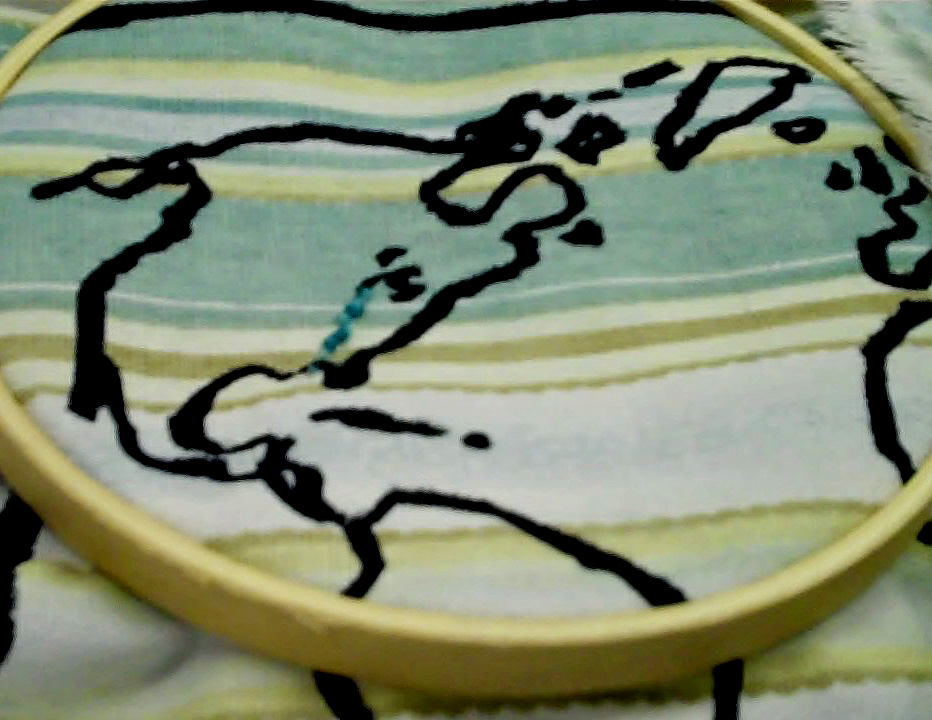
 There was very little time left, but my ultimate goal for the day was to get the kids to start stitching their world maps. I had them look at their paper version first to find North America, locate the Great Lakes and the Gulf of Mexico, and trace the path of the river between the 2. Then I asked them to find the same points on their fabric version. Cindy kindly printed out a transparency for me to project, and I marked and stressed vocabulary source, meander, and mouth. I passed around an example of my own embroidery for them to see and feel what the stitches should look like.
stitched Mississippi
 We quickly handed out supplies and I instructed the  kids how to mount their fabric in the embroidery hoop. I'm calling our needle magnets a "dock" this time instead of a parking spot. And we compared the needle to a boat traveling down the river from the source to the mouth. I showed how to thread the needle and knot the ends and how to do a running stitch following the path they'd drawn.
a bit of a meander
I'm amazed at how quickly and smoothly the stitching went! Perhaps because Cindy has done this with me before she felt more comfortable helping the kids get started- threading and knotting, checking that they'd done it correctly. Perhaps it seemed to go so well just because we were stitching a short line. But I only saw one kid stitch around the hoop, and everybody had nice small stitches (I had stressed tiny,tiny stitches, too)
nice small stitches
I feel very confident about stitching with these kids. Now that I've seen Cindy go through the Mississippi lesson I feel better about being able to lead our other world river lessons. If we'd had enough time today, I would have liked the kids to add images to their world maps with fabric markers or more stitching to show what they understand about the people/animals/uses etc.
I had the flipcam with me, but it's so hard to remember to document when you're in the middle of teaching!